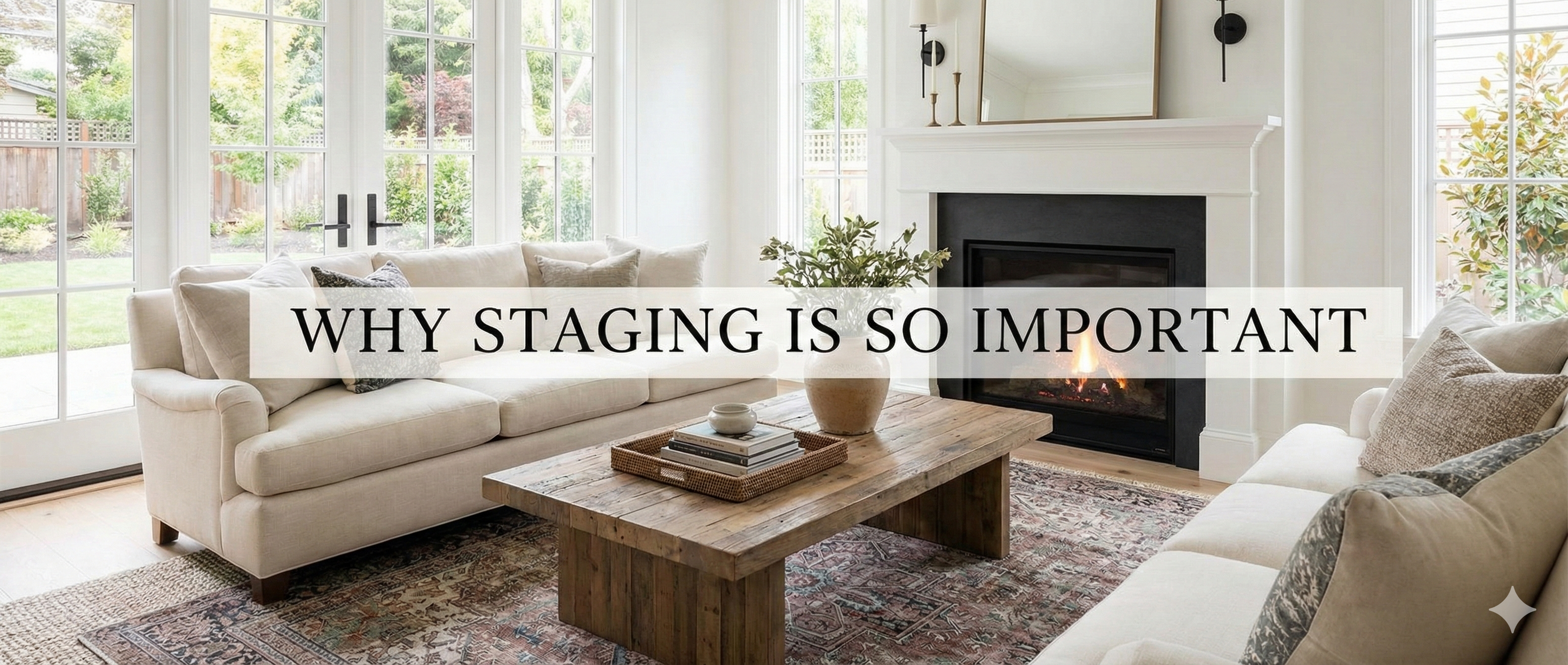
Why Staging a Home is So Important
When it comes to selling your home, home staging can make the difference between selling your house - and selling your house for more money.
When a house is professionally cleaned, staged and showcased at its best, it sells faster and for more money – often tens of thousands more than the unstaged competition.
If you're wondering whether staging is worth the investment, here are just a few benefits of staging that might convince you.
What Is Home Staging? What's involved?
The term ‘staging’ encompasses a lot of activities that help a home look its best. It might involve:
- Decluttering and depersonalizing
- Minor repairs and home improvements like painting or landscaping
- Deep cleaning
- Optimizing the use and flow of every room
- Rearranging furniture or switching out furniture
- Partially or fully furnishing an entire home
- Adding or subtracting accessories, linens
- Enhancing lighting
- Adding greenery and color
What are the benefits of Home Staging?
Staged homes sell for more money. According to the National Association of Realtors 22 percent of seller's agents reported an increase of 1-5 percent of the dollar value offered by buyers, compared to similar unstaged homes. And 17 percent of respondents said that staging a home actually increased the dollar value by 6–10 percent. Numbers like 5 percent may not feel like a lot, until you realize that 5 percent of a $500,000 home is $25,000.
Staged homes sell faster. In addition to the potential for an increased offer, staging has the potential to shorten the length of time your home spends on the market. And if you think about it, that’s money saved, too! A study from the Real Estate Staging Association found that staged homes spend 72% less time on the market. Buyers are just more likely to make a quick offer on a home that looks attractive and feels ready for move-in. Plus, the longer a home stays on the market, the more the price drops — either with an actual price decrease or with lower offers.
It’s easier for Buyers to picture themselves living in a staged home. When we optimize room use and flow, declutter, depersonalize and clean and make design a priority, homes look their best. 77% of Buyers believe that a staged home makes it easier to “visualize the property as their future home”
Staged homes look better in photos, which is how most Buyers first see the home they eventually buy. These days online presence is everything when it comes to real estate marketing. Simply put, a staged home is undeniably more photogenic than an unstaged one. And in the age of Instagram and online searching, photos make a first impression before a potential buyer even has the opportunity to step through the front door.
Staging Demonstrates a Home’s Potential. Regardless of how you personally used a space, staging has the power to offer a glimpse of potential for potential buyers. For example, maybe you used a fourth bedroom as a storage area or a space with gym equipment, electronics or other unattractive gear. Consider transforming it into a guest bedroom through staging, which will help prospects imagine their friends and family staying there when they visit. Or turn it into a playroom to inspire those with young children. Staging helps create meaning out of otherwise empty rooms.
It Can Make a Space Feel Bigger. Believe it or not, a room with furniture can feel larger than an empty room. This may seem counterintuitive, but it’s true! An empty room provides no spatial context, whereas a furnished room allows potential buyers to understand the dimensions of furniture in relation to the room size. It’s hard for people to imagine how much room a king-sized bed might take up, and they may think they’ll need a much larger bedroom than they actually do. Similarly, they can compare the size of a dining room table or sofa in relation to their own furniture to make sure it will all fit nicely.
You’re Going to Pack Up Anyway. This is a minor detail, but worth noting. You’ll need to pack up your home whether or not you decide to stage your home, so why not do it sooner rather than later? Declutter and depersonalize your space by packing and storing unneeded items, personal belongings including trophies, books, signage, collections and other knickknacks on your counters, tables, shelves and walls off-site. The simpler and cleaner the space, the better.
What are the most common rooms that get staged?
According to National Association of Realtors Report:
- Living room (83%)
- Kitchen (76%)
- Master bedroom (69%)
- Dining room (66%)
What should you expect on a Staging Consultation?
The staging consultation includes a complete evaluation of your home and is usually conducted in-person by a professional stager. A written report that includes a room-by-room analysis with a detailed task list for you, the Seller, a staging plan for our team and a timeline.
Real Staging vs. Virtual Staging: What's the Difference?
Real staging involves a professional staging company bringing actual furniture into your space, along with art, lighting, and accessories that create a unique vibe. One that buyers feel the moment they walk in. Or you might stage your home yourself, utilizing your own or borrowed furniture and depersonalizing your space as much as possible. However you plan to stage, know that your efforts are not in vain!
Virtual staging is like Photoshop – it’s just a graphic designer (or virtual staging app) that adds furniture into a digital photo. It looks slick online… right up until a buyer walks in and hears their footsteps echo. Or notices that the furniture in the photos isn’t to scale and wouldn’t actually fit in the room.
When Each Approach Makes Sense
There’s a time and place for both professional staging and virtual staging – but they’re not interchangeable.
Use Professional Staging When:
- Your home is vacant or your furniture doesn’t show well
- You want to wow both online shoppers and in-person viewers
- You’re selling in a competitive price point
- You’re serious about maximizing your sale price
Consider Virtual Staging When:
- Tenants live in the home and won’t/can’t declutter
- You need listing photos yesterday and staging access is tight
- You’re supplementing real staging (e.g., showing a potential reno or layout)
And when it comes to virtual staging, it’s important to remember that it can’t:
- Show scale and flow
- Mask weird layouts
- Enhance the great features of your home
- Help buyers imagine themselves living there
- Trigger that gut-level, emotional connection
Sometimes the on-line and in-person disconnect leads to one thing: disappointment. And disappointed buyers don’t make strong offers.
Virtual staging has its place. But it’s not a strategy—and it’s definitely not a substitute for the real thing. When buyers step into a professionally staged home, they don’t just see furniture. They see lifestyle. They feel possibility. They fall in love. And that’s what sells homes.
Are You Convinced?
All that’s left is to list your home! We can help with that, too. Contact us if you’re looking to sell your home in New Jersey.