Home Pricing Strategies for Sellers: How Should You Set Your Price?
When it comes to selling your home, the right pricing strategy is critical. Think of your asking price as the first number in a negotiation: it sets the tone and shapes buyer expectations.
Price too high, and you risk scaring buyers away, sitting on the market for months, and ultimately settling for less than you could have made. Price too low, and you may sell quickly—but you are leaving money and your hard-earned equity on the table.
So, how do you strike the right balance? Let’s walk through some of the most common pricing strategies sellers use in today’s market—along with the pros, cons, and what to keep in mind before you decide.
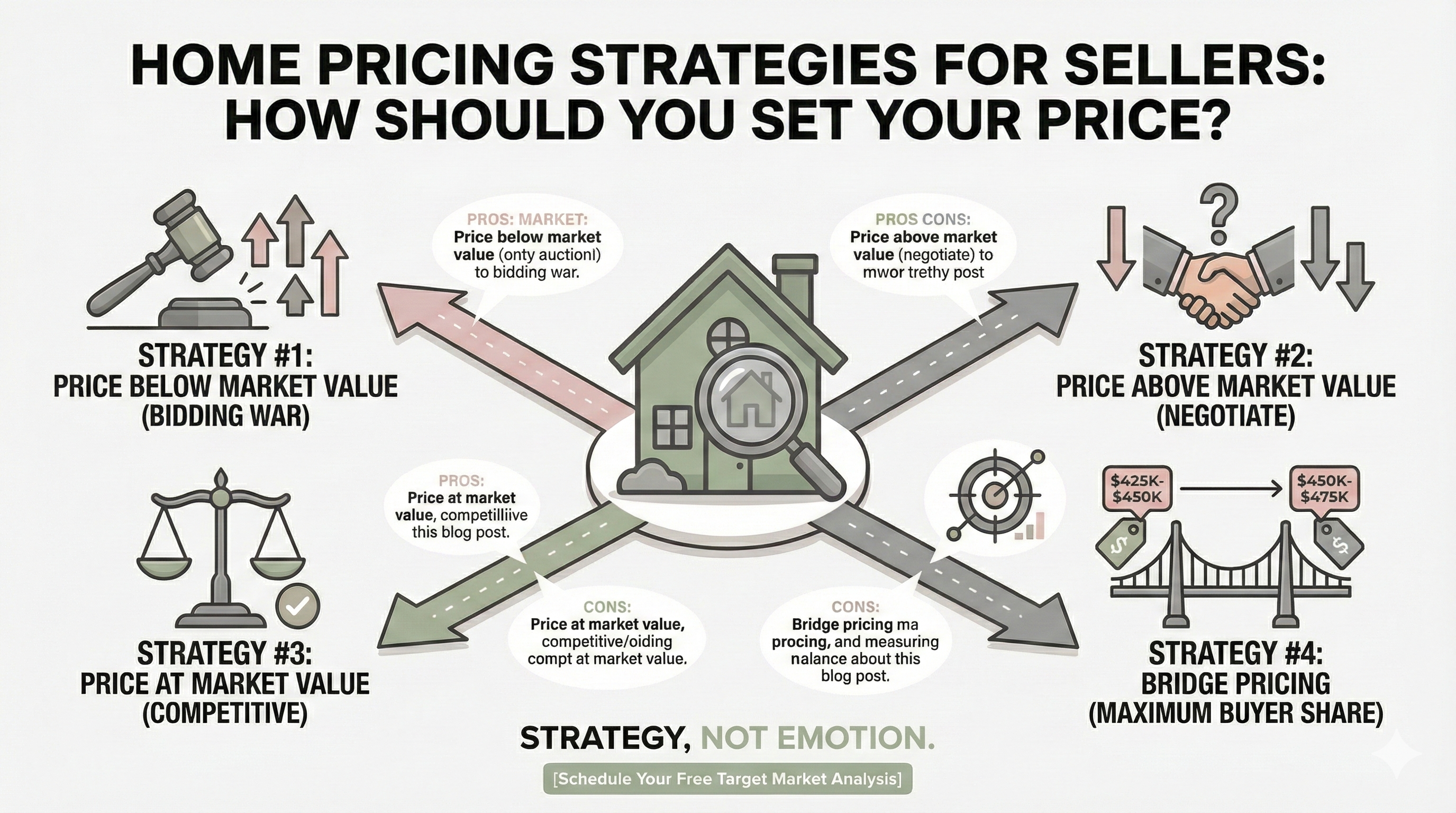
Pricing Strategy #1: Price Below Market Value and Hope for a Bidding War
Pricing low and simulating an auction-like environment can be an effective way to generate a lot of interest in your home in the hopes that multiple Buyers want to make an offer on your house at the same time, thus driving up the price of the house.
For this strategy to work:
- You need to be prepared for the possibility that “offer night” comes and no buyers show up.
- You must be comfortable listing lower than what you believe your home is worth in order to grab attention, which can be risky if you don’t get multiple offers.
- If demand isn’t as strong as expected, you risk underselling.
Think of this as a high-risk, high-reward play. It’s most effective when your agent has a clear read on market conditions and confidence in generating multiple offers.
Pricing Strategy #2: Price Above Market Value and Negotiate
On the flip side, some sellers decide to list above market value, hoping to “leave room to negotiate.” Sometimes this is intentional; sometimes it’s simply optimism.
Either way, here are three realities you should know:
A lot of buyers and their agents don’t like to negotiate and are more likely to walk away than risk insulting a seller with a low offer. Whether or not you agree or disagree with that thinking, the reality is that a high price may alienate some Buyers.
Buyers are usually only excited about a new listing for the first few weeks, and then usually discard it. There’s ample evidence out there that proves that properties that sit on the market because they are priced too high usually end up getting a lower price than they would have, had they priced at market value in the beginning.
Having your home sit on the market for an extended period of time can be really unpleasant if you’re living there. Keeping your home spotless, ready for showings, and vacating at a moment’s notice can wear you down fast. The longer you sit on the market, the more draining it becomes.
Bottom line: pricing too high often backfires. What feels like giving yourself “room to negotiate” can actually result in fewer buyers, less excitement, and a lower final price.
Pricing Strategy #3: Pricing at Market Value
This is often the safest pricing strategy and what most realtors use to get a good price for your home to sell quickly. Pricing at market value positions your home competitively from day one, attracting serious buyers and reducing time on the market.
For this to work, you’ll need a knowledgeable agent who knows how to value a home and of course, all the other factors that affect a sale (staging, marketing, etc.) need to be in place.
When it comes to determining the market value of your home, your REALTOR will look at:
- Recent sales on your street and in your neighborhood.
- Active listings competing for the same buyers.
- Market conditions, including supply and demand trends.
- Unique features of your home (size, upgrades, layout, location perks).
Pricing Strategy #4: Enhancing Pricing Strategy #3 with Target Market Analysis and Bridge Pricing to Capture Maximum Buyer Share
This is an enhancement to the last strategy and my preferred strategy by using Target Market Analysis real-time data to identify where buyers are searching, then pricing at the "bridge" between two price brackets to capture both buyer pools simultaneously.
For this to work, you need to first understand Buyer Search Behavior
When Buyers are searching on online platforms like Zillow, Realtor.com they usually start search in a specific city or zipcode. They then filter by specific price brackets based on their budget and mortgage pre-approval as below:
- $425,000 - $450,000
- $450,000 - $475,000
- $475,000 - $500,000
Your list price decision determines which buyer brackets see your home—and the key is pricing at the bridge so your home is visible to BOTH buyer brackets.
Real Data: Zip Code 08902 Case Study
Here's actual Target Market Analysis real-time showing data from November-December 2025 in zip code 08902 (North Brunswick):
| Price Bracket | Total Showings | % of Market Activity |
|---|---|---|
| $425,000 - $450,000 | 26 showings | 56.52% |
| $450,000 - $475,000 | 18 showings | 39.13% |
| $475,000+ | 2 showings | 4.35% |
Critical insight: 95.65% of all buyer activity concentrates in just two brackets: $425K-$450K and $450K-$475K.
The Bridge Pricing Strategy
Here's the game-changing insight most sellers miss: When you price at exactly $450,000 (the bridge), your home shows up in BOTH bracket searches.
Option A: Price at $449,900
- Visible to $425K-$450K buyers only: Captures only 56.52% of the market share
- These buyers are stretching to their max
- Your home is at the top of their budget
Option B: Price at $450,000 (THE BRIDGE)
- Visible to $425K-$450K buyers: Captures 56.52% of the market share
- ALSO visible to $450K-$475K buyers: Captures also 39.13% of the market share
- You now captures 95.65% of the entire market share
- Higher-bracket buyers are better qualified
- Your home represents great value to them
The difference: Pricing at the bridge ($450,000) vs. below it ($449,900) increases your buyer pool by 39%—from 26 buyers to 44 buyers.
Remember: the price of your home is a moving target. It’s shaped by buyer demand, seasonal trends, and who is your target buyer driven by real-time data.
Price With Strategy, Not Emotion
Get your free Target Market Analysis showing:
- Real-time data showing activity in your zip code
- Which price brackets have most buyers
- Strategic bridge pricing to capture most buyer share